

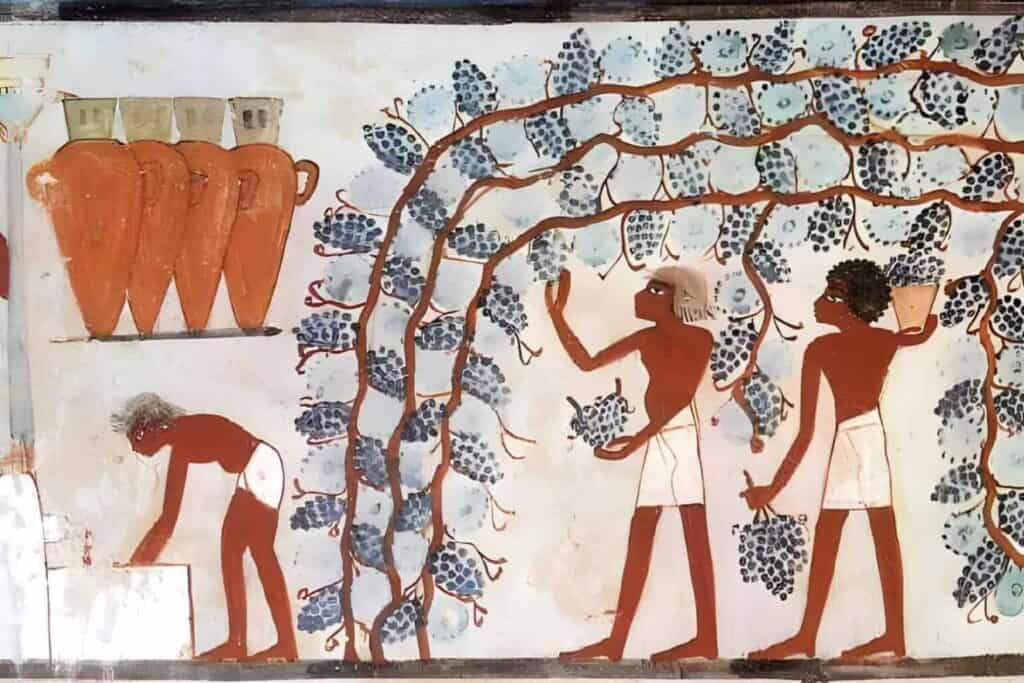
This story is multifaceted and chronologically long. It’s about evolving human genes, getting intoxicated on rotting, yeasty things, having fun and doing sex things with wild species of grapes, and, finally, getting sozzled at an industrial level.
The format: The chronological order here is similar to that of the previous parts of this overall history of food. That is, it’s primarily and overall straightforward but it does become its own order within each subtitled section.
.
IN THE WAY BACK
It was about 10 million years ago that humans not only had the ability to sense ethanol (the fragrance of ripe, edible fruit), they had also evolved to metabolize that ethanol better than earlier primates. They could tolerate it better and would eventually learn to enjoy it more.
Yeast, one of the earliest “domesticated” microorganisms, occurs naturally on the skins of grapes (kind of)., and that would eventually lead to the discovery of alcoholic drinks, including and especially wine.
A very deep detailed genetic study in 2025 (“Spontaneous Fermentation of Raisin Water to Form Wine;” published November 2025 in Scientific Reports) indicated that it wasn’t grapes, per se, that made the first wine (as popularly known); it was raisins. Turns out that although modern wine depends on Saccharomyces cerevisiae, the yeast that most dependably turns sugar into alcohol (it is, after all, called the “wine yeast”), when the researchers took a look at grape skins they consistently found none to very little of this yeast. They also found that S. c. isn’t very good at breaking through the grape skin to get to the fermentable sugars within. Grapes, as fresh and at least alone, simply can’t do the job of creating a spirituous product.
The grape skin, whether wild or in vineyard, supports a “carposphere” (the microbiome on the fruit) consisting of a few species of yeasts and non-yeasts. As just mentioned, Saccharomyces cerevisiae is rare to absent within the carposphere’s community. There is, however, plenty of other microbes, including the yeast-like ascomycetous fungi Aureobasidium pullulans and a bacterium Bacillus subtilis*. It’s the A. p. and others that do the bulk of the initial degradation and assimilation of the starches and cellulose of the grape skin. This A. p. and B. s. (and others) may also somehow protect what little S. c. there may be.
When the decaying microbes break down the grape skin, they expose the digestible sugars — the glucose, fructose, and sucrose — to make them available to S. cerevisiae and probably a couple of other “wine yeasts.” At this point, though, there still isn’t a lot of action by S. c. (if there is any S. c., at all); it still has to find its way, in numbers, to the grape.
The Aureobasidium (and others) also begin the “raisining process,” the sun takes over and shrivels the grapes and voilà, raisins. To achieve that step in the process, it’s all about the grapes being dried in the sun out in the open. It’s at this time and under these conditions that wine yeasts can inoculate the grapes (now becoming raisins). It’s theorized that S. c. as well as other wine yeasts including S. paradoxa, were found (and still are found) in woodlands and untouched old-growth forests (wherever they may be). From there, the wine yeasts may have been carried or to raisin drying mats (or to the vineyards directly, in advance) via wind or yeast-carrying animals (e.g., birds, mammals, or others that feed on such fruit). And S. c. et al now have the potential to kick into serious fermenting mode.
It was sometime before 2,000 BCE that the Egyptians and Phoenicians refined the raisin-making practice by harvesting grape clusters, laying them out on mats, and exposing them to the intense desert or Mediterranean sun for two to three weeks until the moisture dropped and the sugars concentrated.
When rehydrated, raisins, now loaded with S. c. and friends, easily ferment on their own. When soaked in water, they kick off the production of that desired C2H6O (also written as CH3CH2OH or C₂H₅OH) and they do so reliably. C2H6O is, of course, ethanol, the primary alcohol in wine.
There’s something important going on in this process that’s worth noting. The ethanol alcohol now being produced begins to suppress much of the microbes in the mix. Except for one: Saccharomyces cerevisiae, that scarce member of the carposphere. This microbe, THE wine yeast, not only tolerates a rising alcohol level, it multiplies itself and further ups the alcohol.
In ancient, pre-Louis Pasteur (1857 - 1859) times, the science behind soaking raisins for wine might have been known but there are no records of such. There is, however, a practical reason why raisins were used more often than grapes for making wine, microbiology aside. And it has to do with grapes spoiling quickly whereas raisins store well and travel easily.
Soaking raisins produced “raisin yeast” (more properly “raisin yeast water”). This liquid was used for millennia but pretty much vanished soon after commercial yeast was marketed at the Centennial Exposition in Philadelphia in 1876. Only recently has it started to make a comeback for making breads.
[If you’re interested in making bread or wine from raisins, you should know that most store-bought raisins are coated with oil to prevent sticking and this coating blocks fermentation. Only untreated, naturally sun-dried raisins will result in “raisin yeast.”]
Ancient texts describe wines made wholly with raisins, including passum, a wine consumed in the Mediterranean world during Roman times. Fermented grape drinks certainly did not require any deliberate or complex management of yeast. Fresh grapes can ferment under some conditions. But it was the ol’ dried up raisin that made for the rudimentary yet robust process that worked given the food preservation and widespread trade of ancient times, even before the Romans.
[* There’s an unsung hero among the kids on the carposphere block, albeit a different kind of hero. It’s the bacterium Bacillus subtilis. This little guy produces lipopeptides that inhibit Aspergillus carbonarius, a major cause of ochratoxin A contamination in grapes and wine via its start as a disease called “Aspergillus Bunch Rot.” Most wineries use sulfur dioxide (sulfites) in various amounts to fight Aspergillus. Once study showed that B. s. at 200 mg/L outperformed sulfur dioxide in reducing OTA and fungal contamination — without harming yeast growth or wine flavor compounds.
B. s. is also a member of the rhizosphere, essentially the soil microbiome, especially that which clings to the root zones of plants. In that capacity, it improves overall soil health, promotes plant growth, and enhances disease resistance.
Strains of Bacillus subtilis are currently being used against grapevine pathogens, making it a promising tool for sustainable viticulture. It’s also used on horticultural crops for powdery mildew, fire blight, potato scab, selected leaf spots, and various root rots and wilts. It works by both pathogen suppression (it simply overruns the disease organism) and by the production of the lipopeptides, as mentioned, which physically disrupt the cell membranes of pathogens, causing them to leak and die.]
.
EARLIEST CULTIVATION AND PRE-DOMESTICATION
The original species of the grape that is highlighted in this article is Vitis vinifera. It separated from other Vitis species about 12 to 1.3 million years ago. The wild grape is now classified as Vitis vinifera var. sylvestris (what I use from here on) or, in some classifications, as Vitis sylvestris. Vitis vinifera var vinifera (what I use from here on) is the designation restricted to cultivated forms, the domesticated grape. Another name for the domesticated grape, V. v. ssp. sativa, although used by many, is considered obsolete.
Domesticated vines, Vitis vinifera var. vinifera, have hermaphrodite flowers, making them self-pollinating, while V. vinifera var. sylvestris is dioecious (male and female flowers on separate plants) and pollination is required for fruit to develop. This switch may have been the grease for the wheels of domestication; or was it vice versa?
A large and important genetic study in 2023 followed the evolution of V. vinifera var. sylvestris from the time wild vines (sylvestris) split into two populations about 500,000 years ago: a western population/ecotype and an eastern population/ecotype. Then, during the last glacial advance 20,000 years ago, the eastern ecotype of sylvestris split into two groups, each of which gave rise to independent domestication events at almost the same time, 11,000 years ago. One was in the near east, the Levant (which the study labeled as CG1 for “cultivated grape 1”) and one was in the Caucasus (CG2 for “cultivated grape 2”).
The most noteworthy finding from this study: the Caucasus/Georgian/Armenian CG2 varieties were the first domesticated but they did not migrate with the spread of agriculture to Europe and give rise to the grape varieties widely grown today. The CG2 cultivars would mainly be limited to both sides of the Caucasus Mountains with some spread into the Carpathian Basin. The CG2 varieties still around are genetically very different from almost all western varieties.
The CG1 domestication, initially selected for table grapes and not winemaking, would be the ones to influence modern winemaking. From the Levant, these domesticated V. vinifera grapes spread eastward through Central Asia into India and China, along the same pathways taken by other ancient crops. They would also be carried north across the Zagros and Caucasus mountains, and through Anatolia to the Balkans. Their Old World journey would eventually include Iberia and Western Europe. Along the way, there would be a good deal of cross-fertilization and introgression (“back-crossing”).
The finer details of these two starting points, along with the dates of the rest of wine’s history, follows.
9,000 BCE — Management (not yet “domestication”) of wild material (Vitis vinifera var. sylvestris). Most evidence suggests that initial domestication of grape vines took place in the Transcaucasian region (Iran, the Caucasus, and Anatolia) where current-day Georgia and Azerbaijan meet Russia at the very western edge of Asia.
The Levant line of Vitis vinifera would be split at a slightly later date, somewhere between this time and 6,000 BCE, into two horticultural divisions — wine grapes and table grapes — and the cultivation of these two lines would continue separately thereafter.
.
ANOTHER WORLD, ANOTHER COURSE
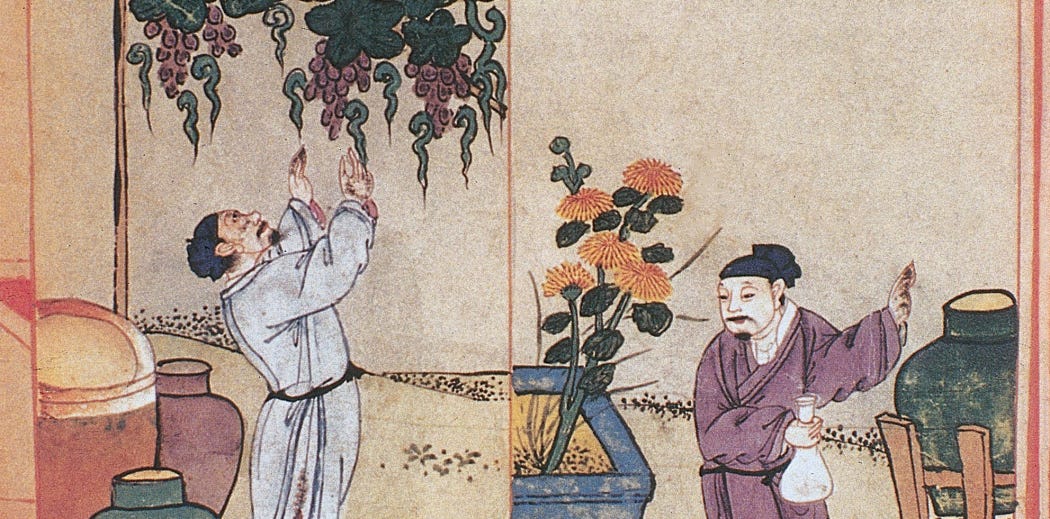
7,000 BCE — Chemical analyses of ancient organics absorbed into pottery jars from the early Neolithic village of Jiahu in Henan province in China have revealed that a mixed fermented beverage of rice, honey, and fruit (hawthorn fruit and/or grape) was being produced. These pottery jars were discovered in the grave of a shaman.
The grape that was found in these jars was probably Vitis amurensis. There are, however, somewhere between 40 and 70 species of wild grape that occur in China, about 20 of which are closely related to V. amurensis. Currently, native species such as V. amurensis, V. bryoniaefolia, V. davidii, V. heyneana, and V. pseudoreticulata, along with the many hybrids among them and with V. vinifera (THE wine grape), are used in the wine industry there.
ca. 1,200 – 1,046 BCE — (Late Shang Dynasty) In the earliest texts from China, at least three beverages were distinguished: chang (an herbal wine), li (probably a sweet, low-alcoholic rice or millet beverage), and jiu (a fully fermented and filtered rice or millet beverage or “wine,” with an alcoholic content of probably 10 – 15 percent; pretty much in the range of today’s actual wine).
1,000 BCE — Archaeologists have discovered wine production from native “mountain grapes” such as V. filifolia and V. thunbergii in China.
551 – 470 BCE — From “Confucius’ Discourses on Eating:” Don’t eat dried meat and drink wine bought from the market. (= Don’t eat processed foods. Know your farmer.)
300 BCE — A grape stem was discovered in the Yanghai Tombs, Turpan District in Xinjiang, China. It was determined to be a specific grape (Vitis vinifera). This is the earliest physical evidence of V. vinifera cultivation in China. Vitis vinifera is not native to China but rather to the Mediterranean region, East-Central Europe, and southwestern Asia (including the Levant and “The Fertile Crescent”).
200 BCE — Zhang Qian (a Chinese diplomat, explorer, and politician ) would explore the Central Asia “countries/kingdoms” of Dayuan and Bactria (Central Asia; the Empire of Alexander the Great; what is now modern Xinjiang,), as well as the Indo-Greek Kingdom (Northwestern India, Pakistan, and Afghanistan). These ventures would not only bring viticulture into Central Asia, it opened up trade that would permit the first wine produced from V. vinifera var. vinifera grapes to be introduced to China.
<618 CE — After many years of restricted foreign intervention, wine was imported again when trade with the west was restored under the Tang dynasty. It would, however, remain mostly imperial fare until the Song Dynasty (from 960 CE) when its consumption spread among those just a bit less fortunate.
1275 to 1292 CE — Marco Polo noted in his account the continuing preference for rice wines in Yuan, China.
.
EARLIEST DOMESTICATED GRAPES AND WINE PRODUCTION
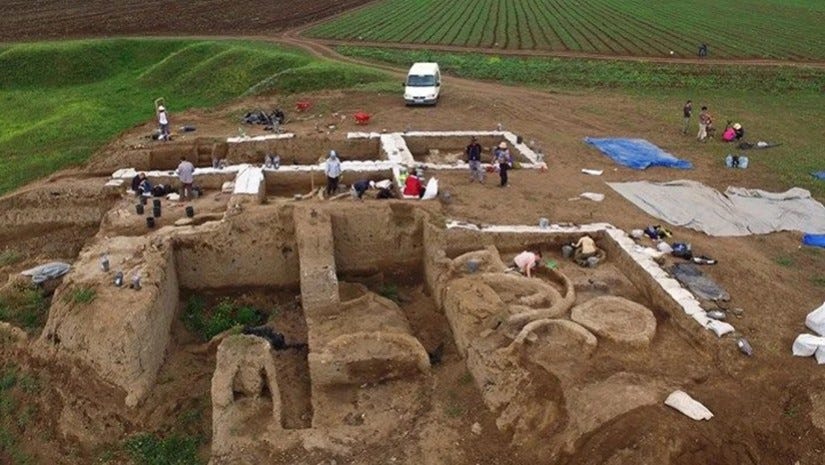
6,000 BCE —The earliest evidence of actual domesticated grapes has been found at two sites in the province of Kvemo (Lower) Kartli in southeastern Georgia: Gadachrili Gora, near the village of Imiri, Marneuli Municipality, and Shulaveris Gora on the Kura River. Dating was done by chemical analyses of ancient organic compounds absorbed into the pottery fabrics and corroborated by climatic and environmental reconstruction and archaeobotanical evidence, including grape pollen, starch, and epidermal remains from a jar of similar type and date.
ca. 5,400–5,000 BCE — Chemical residues inside pots from the Hajji Firuz Tepe site in West Azarbaijan Province, north-western Iran, northern Zagros mountains. The Iranian jars contained a form of retsina (resinated wine) and were sealed with a turpentine pine resin to more effectively preserve the wine.
5,000 BCE — The earliest evidence of charred grape seeds was discovered at Tell Yunnatzi (also, Yunatzi or Yunnatsite), a site in Bulgaria, on the opposite side of the Black Sea from the South Caucasus. In addition to grape seeds, this site contained fragments of ceramic vessels.
4,450 – 4,000 BCE — Seeds from what are believed to be domesticated grapes have been found at Dikili Tash from northern Greece (Macedonia).
ca. 4,100 BCE — So far, the earliest known winery, in the Areni-1 Cave Complex, in Vayots Dzor, southern Armenia along the Arpa River. The site contained a wine press, fermentation vats, jars, and cups. Archaeologists also found V. vinifera seeds and vines. The seeds here were from Vitis vinifera var. vinifera, the domesticated grape. The fact that enology (the science of winemaking) was already so well developed by this time would suggest that the technology probably goes back much earlier.
ca. 4,100 – 3,000 BCE — Changes in grape pip (seed) shape (narrower in domesticated forms) and distribution confirm or suggest that domestication has occurred in southwest Asia, South Caucasus (Armenia and Georgia), and the Western Black Sea shore region (Bulgaria, Romania).
.
THE SPREAD OF WINE
6,000 – 5,800 BCE— As noted earlier, domestication of the grapevine (from Vitis vinifera var. sylvestris to Vitis vinifera var vinifera) most likely took place in two regions at about the same time.
First, in an area encompassing the South Caucasus (also known as Transcaucasia, or the Transcaucasus). It’s where southeastern Europe meets southwestern Asia and was once home to the ancient civilization of Anatolia/Asia Minor. It now corresponds to modern Armenia, Azerbaijan, Georgia, and Iran. Wild grapes (Vitis vinifera var. sylvestris) still thrive in parts of this region.
The other site of origin was in the near east — the Levant (modern day Israel, Palestine, Lebanon, and Jordan), a key part of “The Fertile Crescent.”
These two origins gave rise to a multitude of new Vitis vinifera var. vinifera wine grape cultivars, all varying to some degree, but all sharing almost identical basic features.
The domesticated vines from the Levant are the ones that would make their way westwards with human populations and, through a series of introgressions (accidental and/or intentional cross-breeding with wild vines) in Europe, they would give rise to the ubiquitous Vitis vinifera cultivars (in this case “varietals”) of today.
The domesticated vines from the Caucasus, on the other hand, would stall in place; their genetics would never stray far from Georgia and Armenia. The vast majority of grapes in the world hold the genetic codes from the original domesticated Levantine grapes.
From the Levant, V. v. var. vinifera grapes and their genes, would spread first to Mesopotamia, Egypt, and Crete, and from there they would be carried to the west of the Mediterranean basin. The Phoenician-Punic, Greek, and Roman civilizations were the fundamental traders who spread these grapes to the west.
4,500 BCE — Production technology spread to other sites in “Greater Persia” (aka the “Iranian Cultural Continent,” covering much of the Caucasus, Iraq, Afghanistan, Pakistan, and Central Asia, with cultural influences extending to China and western India).
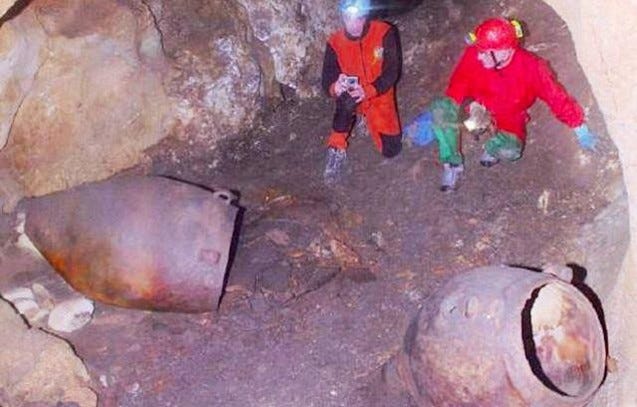
ca. 4,000 BCE — Archaeometric analyses of terracotta jars and amphorae from Monte Kronio in Sicily revealed distinct traces of tartaric acid and sodium salts, confirming the past presence of actual fermented grape wine. Archaeometric = combining various scientific techniques, including radiocarbon dating, Raman spectroscopy, x-ray fluorescence, and laser-induced breakdown spectroscopy, among others. This is 3,400 years before the Greeks were to introduce viticulture and enology to Sicily! 3,000 years before the Phoenician traders had come west! and another “!.”
ca. 3,300 and 3,000 BCE — Discoveries of wine jars at the Tell es-Sakan site of an Egyptian city near the Mediterranean coast, evidently exported wine.
>3,200 BCE — Domesticated grapes from the Levant had become abundant throughout the Near East, with increasingly substantial evidence for winemaking in Sumer and Egypt.
ca. 3100 BCE — Wine jugs discovered in Abydos, Egypt inside the royal Umm el-Qa’ab tombs of the Early Dynastic Period of Egypt. Wine offerings were a common feature of Near Eastern ancient worship.
ca. 3,000 BCE — A royal winemaking industry was established in the Nile Delta and wine would play an important role in ancient Egyptian ceremonial life.
2,700 – 2,200 BCE — Grapes (Vitis vinifera). In Egypt’s Old Kingdom (“The Age of the Pyramids”), both wine grapes and table grapes are grown. Along with figs.
>900 BCE — The ancient Egyptians used a “sack press” made of cloth that was squeezed with the aid of a giant tourniquet. The first wine press?
1,279 BCE — “Palestinian wine.” Included in a menu from the “Papyrus Anastasi IV” (a collection of hieratic and sometimes satirical “miscellanies” or sample letters used for training scribes; generally of a daily life record).
ca. 1,000 BCE — The Phoenicians actively exported the wines of Byblos (an ancient city on the coast of Lebanon; one of the oldest cities in the world), which were known for their quality, to Greece and the Latium and Etruscan lands that would soon become the Roman Empire. More importantly, they would bring grapevines for transplanting.
ca. 600 BCE — The Greeks would further advance viticulture and the production processes of wine and would further spread their knowledge to Sicily, north through the Italian peninsula, and to southern Gaul (France).
300 BCE – 300 CE — Grape seeds preserved in oxygen-free mud of deep wells, at Cetamura del Chianti, an archaeological site in Italy’s Chianti wine region. The majority of the tested seeds belonged to a single, identical variety from the time of the Etruscans and Romans that had been maintained for centuries. Most of these seeds were from a white grape.
200 (or 300) BCE – 220 CE — Grapes and wine are carried along the Silk Road.
ca. 70 BCE — Pliny the Elder, in his “Naturalis historia,” would write “In vino, veritas,” or “In wine, there is truth.” Is this the same as “A drunk mind speaks a sober heart?”
58 – 50 BCE — The ancient Romans further increased the scale of wine production and trade networks, especially in Gaul (Western Europe: present-day Belgium, France, Germany, and Northern Italy), eventually on to Luxembourg, the Netherlands, and parts of Switzerland).
862 CE — Staffelter Hof is built in the Bernkastel-Wittlich district of Rhineland-Palatinate, Germany. The oldest known winery still in existence.
ca. 1000 CE — The vineyards of the Château de Goulaine, located in the Loire Valley of France, begins commercial production of wine. It is the second oldest wine-making business still in existence.
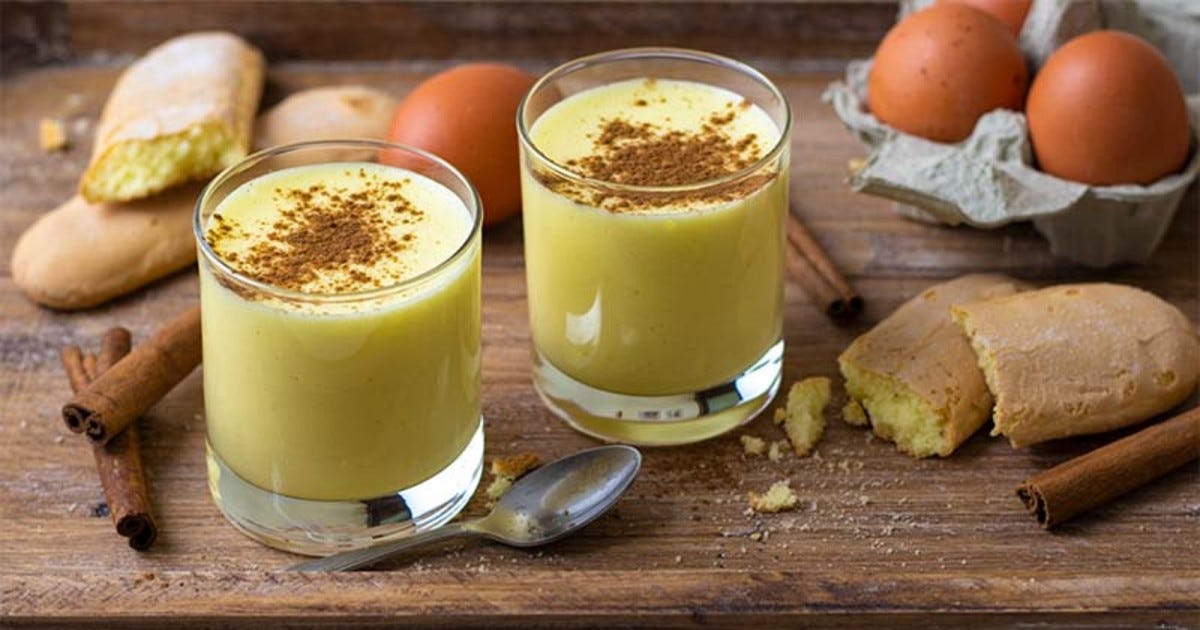
1450s CE — Zabaione (Zabaglione), an Italian dessert, appears for the first time, now found in a recipe in “Cuoco Napoletano.” It’s made with whipped egg yolks, sugar, and a sweet wine (usually Moscato d'Asti).
1773 CE — English merchant John Woodhouse discovered the local fortified wines of Marsala, Sicily. These wines were soon standardized and exported to northern European markets. The island’s viticulture was obliged to expand and modernize through the nineteenth and twentieth centuries with new plantings, vine training systems, and vineyard co-operatives.
1530 CE — The Spanish and Portuguese carry wine grapes to the New World: Brazil and Mexico.
.
WINE ADDITIVES
4,100 BCE — Persians began using pine resin to protect their wines from rotting.
800 BCE — The ancient Greeks blended their wines with fragrances, herbs, brines, and even seawater to enhance flavor, mask oxidation, and boost medicinal properties.
ca. 1st century CE — Sulfur candles were burned inside empty wine vessels to prevent spoilage and oxidation in Ancient Rome and Egypt. Pliny the Elder described how sulfur candles were used to stop vinegar aromas in the amphorae, a practice that secondarily created sulfur dioxide (SO₂) in the wine.
1487 CE — Earliest documented winemaking. A German law approved the burning of sulfur-treated wood chips inside wine barrels to preserve the wine burning sulfur-treated wood chips in barrels.
1777 CE — The formal method of adding beet or cane sugar to unfermented grape juice was first scientifically established by French chemist Pierre Macquer; although people have added sugar to wine since ancient times, initially in the form of honey.
Napoleon’s Minister of Agriculture, Jean-Antoine Chaptal, would popularize it in the early 1800s.
1958 CE — Dr. Harold Olmo (professor at UC Davis, viticulturist, and grape breeder) introduced ‘Rubrired’, a red grape with a red flesh, unlike all previous red grapes. It’s the grape used to help produce Mega Purple and Ultra Red, two dyes/colorants, which were introduced in 1992.
1988 CE — Velcorin (dimethyl dicarbonate or DMDC) is used at the time of bottling to prevent re-fermentation and sterilize the wine by destroying yeast and bacteria.
.
WINE IN THE U.S.
8,500 BCE – 1,000 CE — Although Native Americans had been harvesting and eating wild grapes in North America for at least these 10,000 years, there is no evidence of grape cultivation/domestication before European contact.
8,500 – 8,000 BCE — Grape seeds and remains have been found in sites of this age, including at the Dust Cave site in northwestern Alabama.
8,000 – 1,000 BCE — Grape remains found in the American Bottom region, which stretches from the confluence of the Missouri and Illinois rivers, south to the Kaskaskia River. This floodplain lies directly across the river from modern-day St. Louis. Indigenous peoples consistently gathered and consumed grapes (along with persimmons and wild seed grasses).
16th Century CE — The first European explorers, such as those led by Ponce de León, attempted to make wine from these native grapes, but the results were often unsatisfactory due to their “foxy” flavors.
17th Century CE — European settlers began importing European grape varieties, specifically Vitis vinifera var. vinifera into the Americas. Almost all of these grapes would eventually fail in the Eastern America climate, which left nothing for winemaking.
1619 CE — The first legislation for wine in the US. England wanted wine from its American colony. So, they passed Acte 12, which required every male household in Virginia to plant ten vines of imported vinifera grapes for the purpose of growing and making wine. One of these household males, John Johnson, planted more than ten; he would plant 85 acres worth. This land now belongs to Williamsburg Winery; their signature wine is an Acte 12 Chardonnay.
1683 CE — The first possible recorded planting of a vineyard in western North America was probably by the Spanish Jesuit Missionary Eusebio Francisco Kino at Misión San Bruno in Baja California. He planted a variety named ‘Misionéro’.
Mid 1700’s CE — Benmarl Winery, the oldest vineyard in the United States (holds farm winery license number 1) is still active in New York.

September 17, 1787 CE — The first wine enjoyed after the signing of the Constitution. The signing was celebrated with a glass of Madeira.
1779 – 1781 CE — Franciscan missionaries led by Spanish Father Junípero Serra (Ferrer) planted California’s first vineyard at Mission San Juan Capistrano. Per their Journals, the padres supervised six campesinos (peasants/farmers) brought from Baja California in planting 2,000 grapevines at the new mission. The variety he planted, presumably descended from Spain, became known as the “Mission grape.”
1783 CE — Father Serra would supervise the build of (Alta) California’s first winery, this one in San Juan Capistrano. They would produce red and white wines (sweet and dry), brandy, and a port-like fortified wine called Angelica, all produced from the Mission grape. Father Serra has been called the “Father of California Wine.”
[Just in case you didn’t know, Serra was an appointed Inquisitor; he would file a report to the Spanish Inquisition in Mexico City on “evidences of witchcraft in the Sierra Gorda missions (of Mexico).” From 2015 through 2020, seven statues of Serra in California were either toppled or decapitated, and splattered with red paint; Serra was not popular with the Indigenous peoples.]
<1789 CE — Thomas Jefferson would become America’s first oenophile.
1801 – 1802 — The ‘Catawba’ grape is discovered growing wild in the Carolinas, likely along the banks of the Catawba River.
1830s — Nicholas Longworth (possible inspiration for “Uncle Tom’s Cabin”) planted a vineyard of ‘Catawba’ grapes in Cleveland, Ohio and began producing sparkling wines with traditional methods used in Champagne.
Henry Wadsworth Longfellow would write a poem dedicated to Nicholas Longworth: “Ode to Catawba Wine.”
1839 — Brotherhood Winery, still active today in New York, produces its first commercial vintage.
mid-19th Century — The golden age for New York wineries, with the establishment of major vineyards in the Finger Lakes region, the Hudson River Valley, and Long Island.
1851 —Starting in 1851, Jean-Louis Vignes would plant the largest vineyard in California (at the time), in Los Angeles. He would import vines from Bordeaux — Cabernet Franc and Sauvignon Blanc — and become the first in the U.S. to age wine.
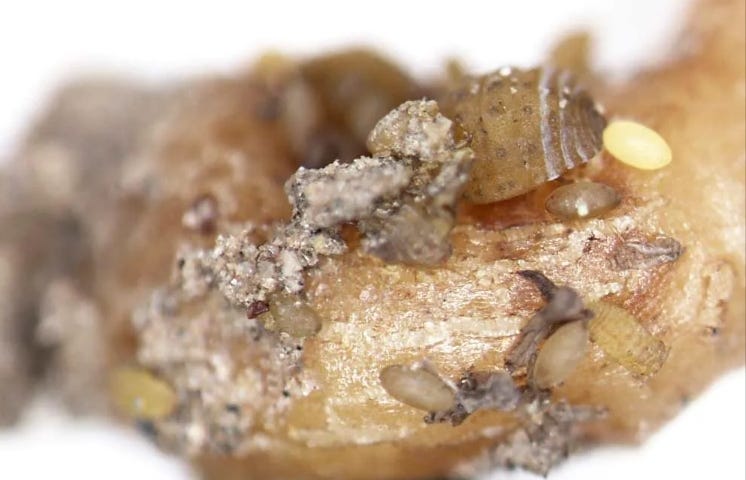
1863 — Cuttings of species of native American grapes were taken to Botanical Gardens in England. They carried an aphid-like pest called phylloxera that attacks and feeds on the vine roots and leaves. Phylloxera is indigenous to North America and native vine varieties, although carrying the pest, had developed resistance. European vines, without such natural defiance, would surrender.
>1865 (just two years!) — The phylloxera had spread to vines in Provence, France. And in twenty years, 75 percent to almost all the vineyards throughout western Europe would be infested and ravaged. The pest would become known as the “Wine Blight.” No pest management practices proved more than temporary, and none were economical.
>1890 — An American horticulturist, Thomas V. Munson, suggested grafting the vinifera vines onto rootstocks of resistant American rootstocks (Vitis berlandieri, V. cinerea, V. cordifolia, and V. riparia, and hybrids thereof). Yes, it was a long, laborious process. But it worked.
1869 — Thomas Bramwell Welch, a supporter of the temperance movement, discovered a method of halting fermentation, hence producing a non-alcoholic wine.

1919 – 1920 — The 18th Amendment to the U.S. Constitution prohibited the manufacture, sale, and transportation of intoxicating liquors for beverage purposes. It was followed by the Volstead National Prohibition Act.
December 5, 1933 — National Repeal. But the wine industry had collapsed; production dropped 94% from 1919 to 1925.
1965 CE — South Australia (not in the U.S.) invented box wine.
1983 — A Phylloxera outbreak would hit Napa Valley and its 400 wineries/vineyards.
2008 — Robert Parker, internationally-renown wine critic, insures his nose and palate for one million US dollars.
.
THE FUTURE OF WINE GRAPES
Under 50 percent of U.S. wineries utilize certified “sustainable” practices. But the numbers are increasing. With increased climate changes, sustainability has become less and “optional” agricultural and business strategy and more compulsory. Just the label and concept of “sustainable” must expand and mature; it must become the more fully integrated and productive “regenerative.” All of us must fix the earth, including viticulturists.
Climate change also demands a change in the plants themselves. Breeders must look at and incorporate the genetics of the more durable native species as well as non-native species from areas of the world that have been through the hotter, drier climate patterns. Breeders should also focus on creating greater diversity in the palette of cultivars (unfortunately, still called “varieties,” which are not to be confused with “varietals”).
Innovation is a good starting point. Regenerative viticulture will be the long-term solution and future of grape growing, whether for wine or table.
For more info on regenerative viticulture, take a look at the Regenerative Viticulture Foundation.
If you’re not a viticulturist, amateur or professional, buy wines labeled “Regenerative” (or at least labeled “Sustainable”).

.
.
I’m having fruit salad for dinner. Well, it’s mostly grapes actually. Ok, all grapes. Fermented grapes. I’m having wine for dinner.
.
NEXT TIME: Back to the regular installments of “20,000 YEARS OF FOOD” with Part 3 (of 7) – To 1 BCE.
.
© Copyright Joe Seals, 2026